
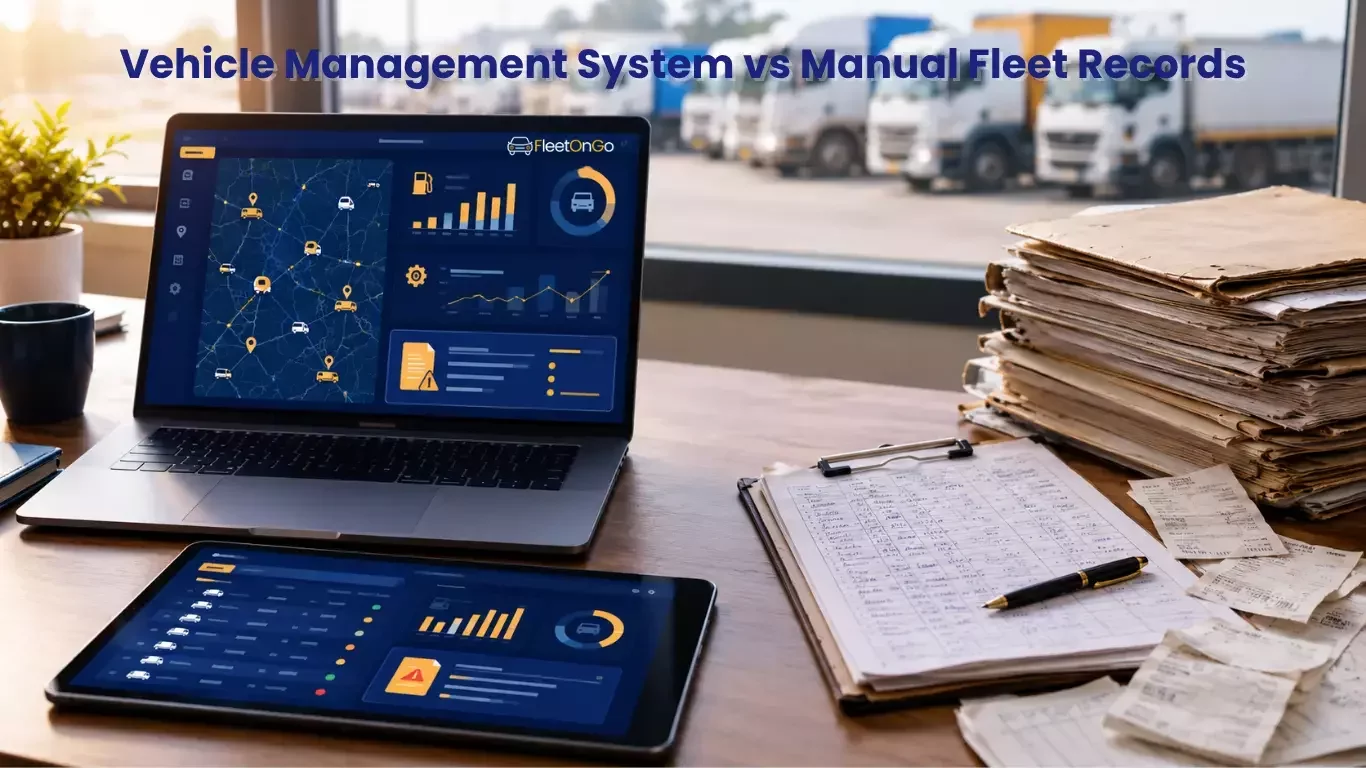
If you're still running your fleet out of a diary, a WhatsApp group, and three Excel sheets that never quite agree with each other, you already know exactly what this article is about. A vehicle management system replaces that patchwork with one place where every vehicle's fuel, maintenance, documents, and driver history actually live — and stay accurate. For small and mid-sized fleet owners across India, moving away from manual fleet records isn't about chasing shiny new tech. It's about not losing another afternoon reconciling a diesel register that a driver "forgot" to fill in for a week.
This piece breaks down what genuinely changes when an SME moves from paper and spreadsheets to a proper digital system, where manual fleet management problems tend to bite hardest, and how to judge whether the switch is actually worth it for a fleet your size.
What Is a Vehicle Management System, Really?
Fleet management software is a cloud-based platform that brings vehicle records, maintenance, fuel, driver compliance, and reporting data into one dashboard. Instead of a fleet manager juggling five different registers and a couple of Excel sheets, a proper fleet management system pulls data from fuel cards, driver apps, and maintenance logs, then turns it into decisions you can actually act on.
Think of it as the difference between flying blind and flying with instruments. You still make the calls — the software just makes sure you're making them with real numbers in front of you, not guesswork.
Why Fleet Management Software Matters More Than Ever
Strip away the marketing language, and a vehicle management system is simply software that centralises everything you currently track by hand: vehicle registration and insurance dates, permits and fitness certificates, fuel consumption, maintenance schedules, and which driver was assigned to which trip. Instead of that information sitting in a driver's notebook, a WhatsApp forward, or a folder of scanned RC copies, it lives in one dashboard that updates in real time.
It helps to be precise about where this ends and a full fleet management systembegins, because the two terms get used interchangeably online and that's where a lot of confused buying decisions start:
Capability | Vehicle Management System | Fleet Management System |
Vehicle records | ✓ | ✓ |
Documents & expiry | ✓ | ✓ |
Maintenance | ✓ | ✓ |
Fuel records | ✓ | ✓ |
GPS/telematics | Optional / via integration | ✓ |
Route planning | Optional / via integration | ✓ |
Driver behaviour | Optional / via integration | ✓ |
Best for | Vehicle records & compliance | Broader fleet operations |
In practice, that "optional / via integration" row is exactly where FleetOnGo sits: the core platform is built around vehicle records, documents, maintenance, and fuel, and GPS or telematics data connects in through API integrations rather than being bundled as in-built hardware — so you're not paying for tracking infrastructure you don't need yet, but the option is there when the fleet grows into it.
Most SMEs start with the record-keeping half — because that's where the daily pain actually is — and add GPS or telematics integrations later, once the fleet is large enough that live tracking earns its cost.
The Real Cost of Manual Fleet Management Problems
Ask any fleet owner who's done a month-end stock-take of fuel slips and repair bills, and they'll tell you the same thing: the numbers rarely add up on the first pass. That's not a discipline problem — it's what happens when your entire record system depends on someone remembering to write something down correctly, on time, every single day. A few of the manual fleet management problems that show up again and again in Indian SME fleets:
- Document expiries caught at an RTO checkpoint, not before — insurance, permits, and fitness certificates that lapse quietly because no one was tracking the renewal date.
- Settlement delays: manual trip-sheet reconciliation can eat up a significant chunk of administrative time at month-end, especially once outstanding client payments and driver advances both depend on the same paper trail.
- Fuel slippage that's nearly impossible to prove without a digital log to compare against — drivers self-report, and there's no independent check.
- No real answer to "which vehicle is actually making us money," because costs are scattered across registers instead of tied to a vehicle ID.
- Breakdowns that hit reactively instead of being caught early, bringing repair costs, vehicle downtime, missed trips, and the occasional awkward call to a client — all harder to plan around when maintenance runs on guesswork rather than a schedule.
Vehicle Management System vs Manual Records: A Side-by-Side Look
Here's the practical difference, stripped of jargon:
What Changes | Vehicle Management System | Manual Records |
Finding a document | A search bar and a few seconds | Flipping through files or calling three people |
Accuracy | Data entered once at the source (a fuel fill, a service visit) | Data copied by hand two or three times, with errors compounding at each step |
Compliance tracking | Automated renewal alerts weeks in advance | Hoping someone remembers the insurance expiry date |
Cost visibility | Per-vehicle profitability visible on a dashboard | Reconstructing it from scratch at quarter-end |
Scaling up | Adding vehicle #21 takes a few clicks | Adding another register and another set of manual entries someone has to remember |
Why Digital Fleet Record Keeping Wins for Growing Fleets
The advantage compounds as a fleet grows, which is exactly when manual systems start to break down.
Compliance Without the Panic
India's AIS-140 standard, notified by the Ministry of Road Transport and Highways, sets out Vehicle Location Tracking Device requirements that apply to specific categories of public service and commercial vehicles, verified against the government's Vahan portal — it isn't a single blanket rule covering every vehicle on the road, and the applicable categories have continued to be refined through newer draft notifications. If your fleet falls under an applicable requirement, keeping the device certification, activation status, and related paperwork organised matters, and it's easy to lose track of when that sits in a separate file from everything else.
Digital fleet record keeping won't tell you which specific mandate applies to your vehicle category — that's still a conversation with your RTO or a compliance advisor — but it does bring the certificates, activation records, and renewal dates into the same system that already tracks fuel and maintenance, so nothing gets missed simply because it was filed in a different drawer.
Real-Time Visibility Instead of End-of-Month Surprises
With fuel and maintenance data updating continuously rather than being tallied once a month, fleets tend to catch inefficiencies while they're still small rather than discovering them at quarter-end. Where a fleet also brings in GPS or telematics through an API integration — layering route optimisation and idle-time monitoring on top of the core vehicle records —industry benchmarks commonly cite fuel savings in the high-single to low-double-digit percentage range. Worth treating that as a benchmark rather than a guaranteed outcome — actual savings depend heavily on how consistently the data gets acted on, not just on having the dashboard.
Choosing Vehicle Record Management Software: What SMEs Should Look For
Not every platform is built with a small or mid-sized fleet in mind — a lot of tools are designed for large enterprise operations and simply scaled down in price, without scaling down the complexity. When you're evaluating vehicle record management software as an SME, a few things matter more than a long feature list:
- Per-vehicle pricing that scales down honestly, not a flat enterprise fee dressed up as an SME plan.
- A mobile app drivers will actually use — if logging a fuel fill takes longer on the app than on paper, driver adoption can quickly become a problem.
- Automated document-expiry alerts tied to India-specific requirements (insurance, permits, fitness, AIS-140 certification).
- API integrations, so the system connects to accounting or GST invoicing tools instead of becoming yet another island of data (see how driver management and vehicle records can sit in the same platform).
- A support team that understands state-level RTO variation, not a generic global template.
Fleet Management Software for SMEs: Is It Worth the Switch?
For a two- or three-vehicle operation, a well-kept spreadsheet can still get the job done. Many SMEs start feeling the limits of spreadsheets as the fleet grows beyond a handful of vehicles — particularly once more than one person is entering or relying on the same records, which is usually where the small inconsistencies start piling up. That's typically the point where fleet management software for SMEs can become increasingly cost-effective — through fewer missed renewals, less fuel slippage, and maintenance that happens on schedule instead of after something breaks. It won't fix a fleet with deeper operational issues overnight, but it does remove the guesswork that manual records simply can't.
Vehicle Management System vs Excel: When a Spreadsheet Stops Being Enough
For a lot of SMEs, the real alternative to a vehicle management system isn't a paper register at all — it's a shared Excel or Google Sheets file that someone set up years ago and everyone's been patching ever since. It's worth being honest about where that actually holds up, and where it quietly starts working against you.
- Excel genuinely works for a very small fleet with one person owning the file and a light update schedule — there's no need to over-engineer that.
- The trouble starts with multiple users: two people editing the same sheet at once, a formula someone accidentally overwrites, or a copy that gets emailed around and forked into three slightly different "latest" versions.
- Expiry reminders depend entirely on someone opening the file and scrolling to check dates — there's no alert that reaches you before an insurance or permit renewal is due.
- Maintenance history tends to fragment across tabs, workshops, and WhatsApp photos of service bills, so there's rarely one clean record per vehicle to refer back to.
- A centralised system removes the version-control problem entirely and turns expiry tracking into an automatic alert rather than a manual check — which is usually the single biggest quality-of-life change owners notice in the first month.
None of this means Excel is the wrong tool on day one. If you're running two or three vehicles and one person handles all the updates, a well-structured spreadsheet is a perfectly reasonable starting point. The switch tends to make sense once a second person needs regular access to the same records, or once you've been caught out by a renewal date more than once.
Making the Switch: A Practical First Step
Don't try to digitise five years of paper history in one weekend — that's how switches stall out. A cleaner approach:
- Start with your active fleet only; historical records can be scanned and archived separately later.
- Run the new system alongside your existing register for one full billing cycle before retiring the paper trail, so you can catch any mismatches.
- Migrate document expiry dates first — that's the single biggest source of manual fleet management problems, and the easiest win once it's automated.
If you want to see what this looks like on a real dashboard rather than in theory, FleetOnGo's fleet management features page walks through the vehicle, fuel, and maintenance modules together, and you can talk to the team about a 14-day free trial to test it against your own fleet before committing to anything.
The honest takeaway: a vehicle management system doesn't just digitise what you're already doing — it removes the single points of failure that manual fleet records depend on. For a growing SME fleet, that's usually reason enough to make the move sooner rather than later.
