
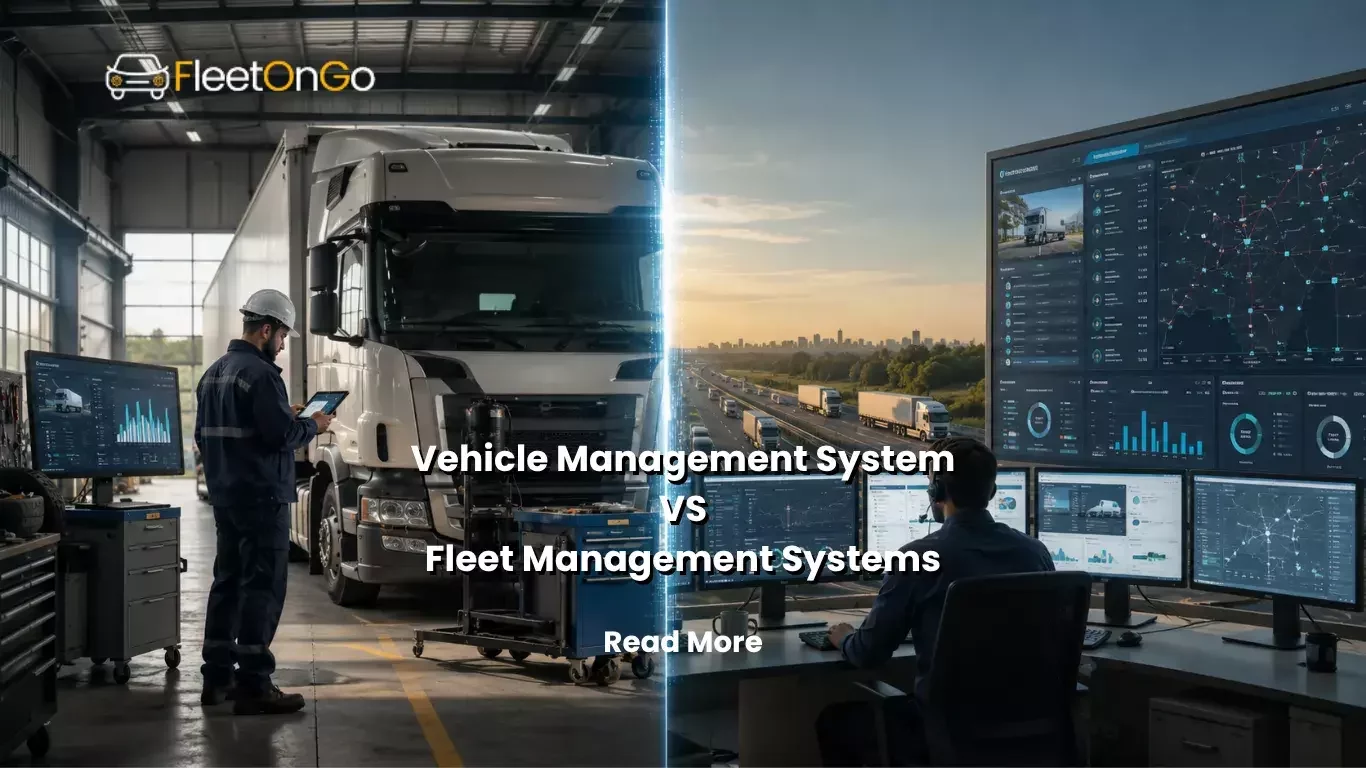
Which Does Your Business Need?
Ask five fleet owners to define a “vehicle management system” and you'll get five different answers. One thinks it's just a maintenance log. Another swears it means GPS tracking. A third assumes it's the same thing as fleet management software, just with a fancier name. Honestly? That confusion costs money — businesses end up buying tools that are either overkill for a two-van delivery run or too thin for a hundred-truck logistics operation.
This post is a straightforward fleet software comparison. We'll unpack what each term actually means, where they overlap, where they diverge, and how to pick the right vehicle tracking software or full fleet management platform for your business today — not the one you might need three years from now. (If you want the fundamentals first, our what is fleet management guide covers the basics; this piece is about the decision, not the definition.)
Not sure which category fits your operations? You can try FleetOnGo's free trial
What Is a Vehicle Management System, Really?
A vehicle management system (VMS) is built around the vehicle itself. Picture it as the digital version of a glovebox folder: registration renewals, insurance dates, service history, fuel logs, odometer readings, and warranty tracking, all in one place instead of scattered across spreadsheets and sticky notes.
It's asset-centric. The core question a VMS answers is simple: is this vehicle roadworthy, and when does it need attention next? Most VMS tools are, at their core, a lighter version of fleet maintenance softwarebuilt for a handful of vehicles rather than an entire commercial fleet.
Core Functions of a Vehicle Management System
- Maintenance scheduling and service-due alerts
- Document storage for registration, insurance, and permits
- Fuel consumption and cost-per-kilometre tracking
- Odometer readings and vehicle health logs
- Depreciation and total cost of ownership records
Who Actually Needs Just a VMS?
If you're running a handful of company cars, a small delivery fleet, or vehicles that mostly stay put between jobs, a standalone VMS might genuinely be enough. You don't need route planning software for three vehicles doing local drop-offs — you need to know when the next service is due and whether the insurance has quietly lapsed.
What Is a Vehicle Fleet Management System?
A vehicle fleet management system takes everything a VMS does and layers operational intelligence on top of it. It's not just asking “is the vehicle okay?” — it's asking “is this vehicle being used well, is the driver behaving safely, and is the whole fleet moving efficiently?” That's a business question, not just an asset question, and it's why most commercial fleet software is sold as a platform rather than a single tool.
Where Fleet Management Software Goes Further
GPS Fleet Management and Live Vehicle Tracking
Instead of an odometer reading logged once a month, GPS tracking software gives you live location, speed, and idle time for every vehicle. Paired with proper vehicle tracking software, a fleet monitoring system can flag an unscheduled stop or route deviation within seconds, not at month-end.
Route Optimisation and Dispatch
Built-in route planning reshuffles trips in real time based on traffic and delivery windows, then assigns the nearest available vehicle instead of whichever one happens to be free. Over hundreds of trips, that shaves real money off fuel bills — which is also where dedicated fuel management tools earn their keep, flagging pilferage and unusual consumption patterns automatically.
Driver Behaviour and Regulatory Compliance
Harsh braking, idling time, speeding patterns, and duty-status logs are captured automatically instead of scribbled on paper. In the US, this kind of automated logging is required for most commercial drivers under the FMCSA's electronic logging device rule, a federal regulation that replaced paper logbooks to reduce fatigue-related risk on the road.
India has a comparable, though narrower, requirement. Under the Ministry of Road Transport and Highways' AIS-140 standard, certified GPS units with panic buttons and live data sharing to the government's Vahan portal are mandatory for public service vehicles and specified categories of commercial transport, such as buses, taxis, and goods carriers operating under state permits. It is not automatically required for every commercial vehicle in the country — applicability depends on vehicle category, permit type, and state-level enforcement, so it's worth checking current rules with your local RTO or our AIS-140 guide before assuming your fleet is exempt either way.
Fleet Management Dashboard: The Feature That Changes Everything
If one feature separates a basic VMS from a true fleet operations software platform, it's the fleet management dashboard. This is the command centre — a single screen where a manager sees every vehicle's location, fuel burn, driver status, and maintenance flags without opening ten different tabs or reconciling three spreadsheets.
What You Should See on a Good Dashboard
- Live map view of every vehicle, with idle and moving status
- Colour-coded alerts for overdue maintenance or expiring documents
- Fuel efficiency trends by vehicle and by driver
- Driver safety scores and harsh-event flags
- Fleet analytics and exportable reports ready for compliance audits
A cluttered dashboard is worse than no dashboard at all. If your dispatcher needs a training session just to find yesterday's mileage report, the tool isn't doing its job. FleetOnGo's fleet dashboard is built so a new team member can pull a useful answer within their first ten minutes on the job.
Vehicle Management System vs Fleet Management System: Feature Comparison
Here's the side-by-side that most “vehicle management system vs fleet management system” searches are really after:
Feature | Vehicle Management System | Fleet Management System |
Maintenance Tracking | Yes | Yes |
GPS / Vehicle Tracking | Limited | Advanced, real-time |
Driver Behaviour Monitoring | No | Yes |
Dispatch & Job Assignment | No | Yes |
Route Optimisation | No | Yes |
Regulatory Compliance | Basic (documents) | Advanced (AIS-140, ELD, HOS) |
Reporting & Analytics | Basic logs | Fleet analytics & dashboards |
Best For | Small fleets (1–10 vehicles) | Growing / multi-city fleets |
Cost Comparison: Is the Upgrade Worth It?
The honest answer is: it depends on what a missed delivery or an unplanned breakdown actually costs you. Here's how the three tiers generally break down.
Basic VMS: Low monthly cost, minimal setup, good for tracking paperwork and service dates on a handful of vehicles. You'll still be manually checking locations and fuel spend.
Mid-level Fleet Software: Adds live GPS tracking, a fleet dashboard, and basic route planning. This is where most growing fleets land, since the fuel and time savings usually offset the higher subscription within a few months.
Enterprise Fleet Platform: Full transport management system capability — dispatch automation, driver scorecards, deep compliance reporting, and API integrations with ERP or billing systems. Worth it once you're running multi-city operations or regulated cargo.
If you want exact numbers for your fleet size, FleetOnGo's fleet software pricing page breaks down plans by vehicle count rather than one flat rate.
Vehicle Management System vs Transportation Management System: A Quick Clarification
Which One Does Your Business Actually Need?
Choose a Vehicle Management System If…
- You manage under 10 vehicles running predictable, local routes
- Your biggest pain point is missed services or expired paperwork, not route inefficiency
- You don't need real-time driver or location visibility
Choose a Fleet Management System If…
- You run 10 or more vehicles, especially across cities or states
- Fuel cost, driver safety, or delivery delays are already hurting your margins
- You need commercial fleet software that can prove compliance under AIS-140, ELD, or a similar mandate
- You want one dashboard instead of juggling GPS apps, spreadsheets, and paper logs
Making the Switch: What to Look For
If you've outgrown a basic VMS, don't just chase the platform with the most features. Look for a system that layers cleanly onto what already works — one that keeps your fleet maintenance software running smoothly while adding the live GPS tracking, route planning, and compliance reporting you actually need.
A well-built vehicle fleet management system should feel less like new software and more like the operations manager you wish you could afford to hire. Start with your single biggest pain point — compliance, fuel cost, or downtime — and pick the tool that solves that first. And if you're still weighing it up, compare fleet management plans side by side before committing to a full rollout.
