
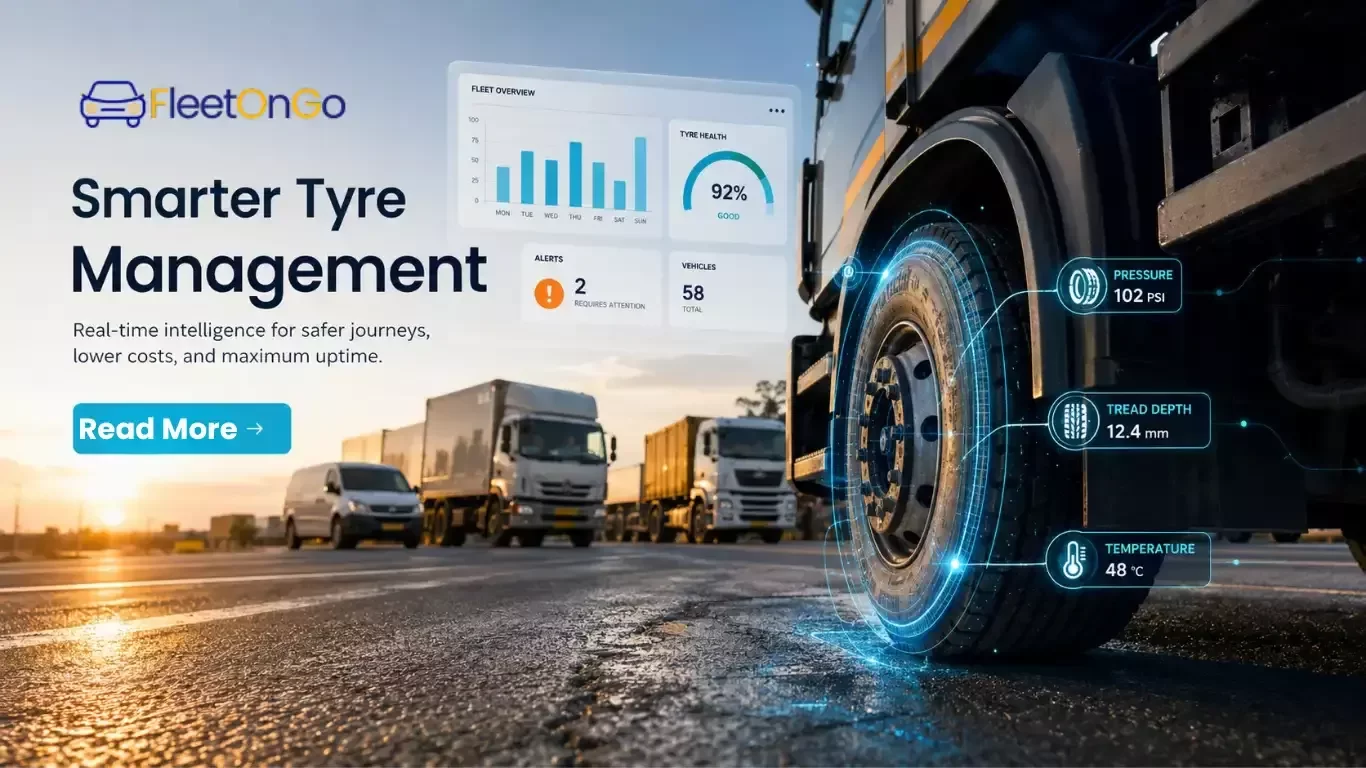
The Complete Guide for Indian Fleet Operators
Tyres are among the largest recurring costs in any commercial fleet — and when they’re under-managed, they drain budgets and raise safety risk. If you still rely on spreadsheets or driver reports, you’re losing money and exposing your fleet to avoidable breakdowns.
India’s Ministry of Road Transport & Highways (MoRTH) data shows that vehicle defects — including tyre failures — contribute to thousands of road accidents every year. The fix isn’t just operational; it’s strategic. Fleet tyre management software gives you the systems to prevent failures before they happen.
External reference (India): MoRTH Road Accidents in India Report
Why Tyre Management Is a Hidden Cost Centre in Fleet Operations
Industry studies and fleet vendor case studies consistently show tyres account for ‘20–30%’ of a fleet’s total maintenance budget. That’s not a small number — and a significant portion is avoidable through better inflation practices, timely rotation, and smarter procurement decisions.
For US benchmark data on vehicle tyre safety, the FMCSA Vehicle Safety Resources provide useful comparison context — though Indian fleets operate under their own regulatory framework (Motor Vehicles Act, CMVR rules).
Spreadsheet vs. Tyre Management Software: At a Glance
Searching for ‘tyre management spreadsheet vs software’? Here’s a direct comparison to help you decide:
Capability | Spreadsheet / Manual | Fleet Tyre Management Software |
Tyre pressure monitoring | Manual entry, often delayed | Real-time TPMS alerts, automatic |
Wear & tread tracking | Inconsistent, driver-dependent | Digital logs with photo evidence |
Maintenance scheduling | Calendar reminders (easy to miss) | Auto-alerts by mileage or date |
Cost analytics | Manual calculations | Dashboards by vehicle, driver, route |
Compliance records | Paper-based or fragmented files | Digital audit trail, timestamped |
Inventory management | No real-time view | Live spare tyre stock visibility |
Mobile access for drivers | None | Full mobile app with offline support |
The Most Common (and Costly) Tyre Problems Indian Fleets Face
Under-inflation: Causes accelerated wear, poor fuel economy, and blowout risk on highways
Skipped rotations: Leads to uneven wear patterns and early replacement cycles
No centralised records: Losing track of tyre age, brand, or mileage per unit
Reactive replacements: Acting only after a failure instead of preventing it
Late driver reporting: Tyre issues flagged too late — or not at all
The Most Common (and Costly) Tyre Problems Indian Fleets Face
- Under-inflation: Causes accelerated wear, poor fuel economy, and blowout risk on highways
- Skipped rotations: Leads to uneven wear patterns and early replacement cycles
- No centralised records: Losing track of tyre age, brand, or mileage per unit
- Reactive replacements: Acting only after a failure instead of preventing it
- Late driver reporting: Tyre issues flagged too late — or not at all
What Is Fleet Tyre Management Software?
Think of it as a command centre for every tyre across your fleet. Good fleet tyre management software tracks tyre health in real time, automates replacement alerts, logs maintenance history, and surfaces cost-saving patterns you’d never catch manually.
The platform connects directly to your vehicle data. Everything logs automatically, and alerts fire before a problem becomes a breakdown.
Core Features That Actually Move the Needle
1. Real-Time Tyre Pressure Monitoring (TPMS Integration)
Low tyre pressure is the #1 cause of tyre failure. TPMS integration alerts your team the moment pressure drops below safe thresholds — not after the driver pulls over with a flat on a national highway.
2. Tread Depth & Wear Pattern Tracking
Digital inspection logs capture tread depth at every scheduled service. Over time you’ll see which vehicles burn through tyres fastest — and whether it’s the route, driver behaviour, or vehicle load that’s driving it.
3. Automated Maintenance Scheduling & Alerts
No more chasing service dates. The system schedules rotations, alignments, and replacements based on actual mileage and wear data. You’ll receive alerts well in advance so you can plan around vehicle availability.
4. Fleet-Wide Tyre Inventory Management
Know exactly how many spare tyres you have, where they are, and when they were last inspected. The system’s inventory tracking ensures you’re never caught short — and never holding excess stock that ties up capital.
Does the software pay for itself? Industry case studies and fleet operator reports consistently show yes — often within six to twelve months. Here’s how the savings stack up:
- Fuel efficiency: Properly inflated tyres improve fuel economy by up to 3% (U.S. Department of Energy). On a 50-vehicle fleet running daily long hauls, that compounds fast.
- Extended tyre lifespan: Timely rotation and inflation management can extend tyre life by 15–25%, according to fleet maintenance vendor case studies, directly reducing replacement frequency.
- Fewer breakdowns: Unplanned breakdowns typically cost Indian fleets ₹4,000–8,000+ per incident when you factor in towing, lost productivity, and driver downtime.
- Smarter procurement: Historical wear data lets you negotiate better terms with tyre suppliers and choose brands that last longer on your specific routes and load types.
Source: U.S. Department of Energy – Tyre Inflation & Fuel Economy
“After switching to Fleetongo’s tyre tracking, we reduced unplanned tyre replacements by 30% in the first quarter. Our logistics coordinator no longer has to call drivers for updates — everything is visible on the dashboard.”
— Fleet Operations Manager, mid-sized logistics company, Pune, Maharashtra
Cost savings matter — but safety compliance is non-negotiable. India’s Motor Vehicles (Amendment) Act and Central Motor Vehicles Rules (CMVR) place clear legal responsibility on fleet operators to maintain vehicles in roadworthy condition. Tyres are explicitly covered.
Fleet tyre management software creates the digital audit trail you need. Every inspection, alert, and maintenance action is logged with timestamps and user records — exactly what you need if you’re audited by state transport authorities or if a tyre-related incident ever leads to an investigation.
India compliance reference: Central Motor Vehicles Rules – MoRTH India
Safety Features Built Into Modern Tyre Monitoring Platforms
Driver pre-trip inspection checklists with digital sign-off (replaces paper forms)
Photo evidence uploads for remote inspection validation
Integration with fleet telematics to flag harsh braking patterns that accelerate tyre wear
Incident logging linked to tyre condition at the time of the event
Automatic alerts when tyres approach legal minimum tread depth
Most generic fleet platforms treat tyres as an afterthought. This tyre management solution was built with Indian fleet realities in mind — diverse vehicle types, mixed terrains from city streets to state highways, and the need for mobile-first access by drivers and supervisors in the field.
TPMS integration: Connects directly with tyre pressure sensors for real-time fleet tyre monitoring
Cost analytics dashboards: Tyre spend broken down by vehicle, route, driver, and brand
Vendor management: Compare tyre suppliers, track warranties, and manage service contracts within the platform
Multi-vehicle support: 2-wheelers to heavy commercial trucks, all under one roof
Mobile-ready inspections: Drivers log tyre checks from their phones; data syncs instantly to your dashboard
Not all platforms are created equal. Before you commit, look for these non-negotiables:
Must-Have Capabilities
- Real-time TPMS integration or structured manual inspection logging (ideally both)
- Automated alerts triggered by mileage milestones, not just calendar dates
- Detailed cost reporting broken down by vehicle, route, and tyre brand
- Mobile app for drivers and field technicians with offline mode support
- Integration with existing fleet management or ERP systems
- Tyre vendor and warranty management tools
Also look at how intuitive the interface is for your maintenance team. A powerful tool nobody uses isn’t powerful at all.
Don’t try to overhaul everything at once. Start with these high-impact steps:
- Audit your tyre inventory. Log every tyre on every vehicle — age, brand, tread depth.
- Set inflation benchmarks. Define target PSI per vehicle type and configure alerts accordingly.
- Train your drivers. Get your team comfortable with mobile inspection logs — it takes under a day.
- Review month-one data. Identify vehicles with outlier wear and investigate root causes.
FAQ: Fleet Tyre Management Software India
Ready to Cut Tyre Costs and Improve Fleet Safety?
Tyre management doesn’t have to be a reactive, expensive headache. With the right fleet tyre management software, you get ahead of problems, cut unnecessary spend, and keep your vehicles — and drivers — safer on Indian roads.
Fleetongo brings everything together in one platform built for Indian fleet realities. Whether you manage 5 vehicles or 500, the tools are there to help you run a tighter, safer, and more cost-effective operation.
➤ Book your free Fleetongo demo today and find out exactly how much your fleet could save.
